

Staying emotionally aware between therapy appointments is one of the hardest parts of the mental health journey. You leave a session feeling clear and motivated, but by day three or four, that clarity fades and small emotional shifts go unnoticed until they pile up. Daily mental health check-ins solve this problem by giving you a structured, low-effort way to tune into your feelings every single day. This guide walks you through exactly how to build a check-in workflow that fits your life, strengthens your self-awareness, and gives your therapist genuinely useful information to work with.
Table of Contents
- Gather your tools and set your intentions
- Step-by-step: How to perform a daily mental health check-in
- Troubleshooting: Common challenges and what to do about them
- Making your check-in insights work in therapy
- Why "perfect" tracking isn't the goal—focus on self-compassion
- Easily track your progress between therapy sessions
- Frequently asked questions
Key Takeaways
| Point | Details |
|---|---|
| Consistency matters most | Daily check-ins, even brief, are more valuable than aiming for perfection. |
| Use evidence-based tools | Digital apps and validated trackers provide reliable, actionable data for mental health. |
| Temporary setbacks are normal | Feeling worse at first is common, so pair tracking with self-compassion and talk with your therapist. |
| Integrate with therapy | Bringing your data to therapy sessions turns reflection into growth and deeper insights. |
Gather your tools and set your intentions
Before you log a single mood rating, it helps to get clear on why you're doing this. Tracking your mood is not just about collecting numbers. It's about creating a living record of your emotional experience so you can spot patterns, prepare richer therapy topics, and take better care of yourself on hard days. When you know your "why," you're far more likely to stick with the practice.
Choosing the right tracking format matters more than you think. The best tool is the one you'll actually open every day. Some people love the tactile feel of a paper journal. Others prefer a quick digital entry on their phone. A few like structured worksheets they can print. Each format has genuine strengths.
Here's a quick comparison of the most common mood tracking methods:
| Method | Best for | Effort level | Therapy-ready? |
|---|---|---|---|
| Paper journal | Deep reflection, privacy | Medium | Manual review needed |
| Mood tracking app | Pattern visualization, reminders | Low | Often yes, with export |
| Printed worksheets | Structured prompts, offline use | Medium | Yes, bring to session |
| Wearable/passive sensing | Automatic data, no effort | Very low | Requires interpretation |
| Spreadsheet | Custom metrics, data lovers | High | Yes, with charts |
Research backs up the value of going digital when consistency is your goal. Digital mood tracking programs achieve effect sizes matching psychotherapy benchmarks, which means a well-designed app or digital tool can produce measurable improvements in depression and anxiety comparable to formal therapy interventions.
Once you've picked your format, gather these basics before your first check-in:
- A dedicated notebook or app installed and ready to open
- A short list of 3 to 5 prompts you want to answer daily (more on these below)
- A consistent time slot blocked in your calendar or set as a phone reminder
- A quiet space where you won't be interrupted for five to ten minutes
Setting a clear intention is the final setup step. Ask yourself: what do I want to get out of this? Maybe you want to notice what triggers your anxiety. Maybe you want to track how sleep affects your mood. Maybe you just want to feel less caught off guard in therapy sessions. Write that intention down somewhere visible. It becomes your anchor on days when the habit feels pointless.
Pro Tip: Keep your tracking tool in a visible spot, like your nightstand or your phone's home screen. Reducing the friction between you and the habit is one of the most effective ways to make it stick long-term.
Step-by-step: How to perform a daily mental health check-in
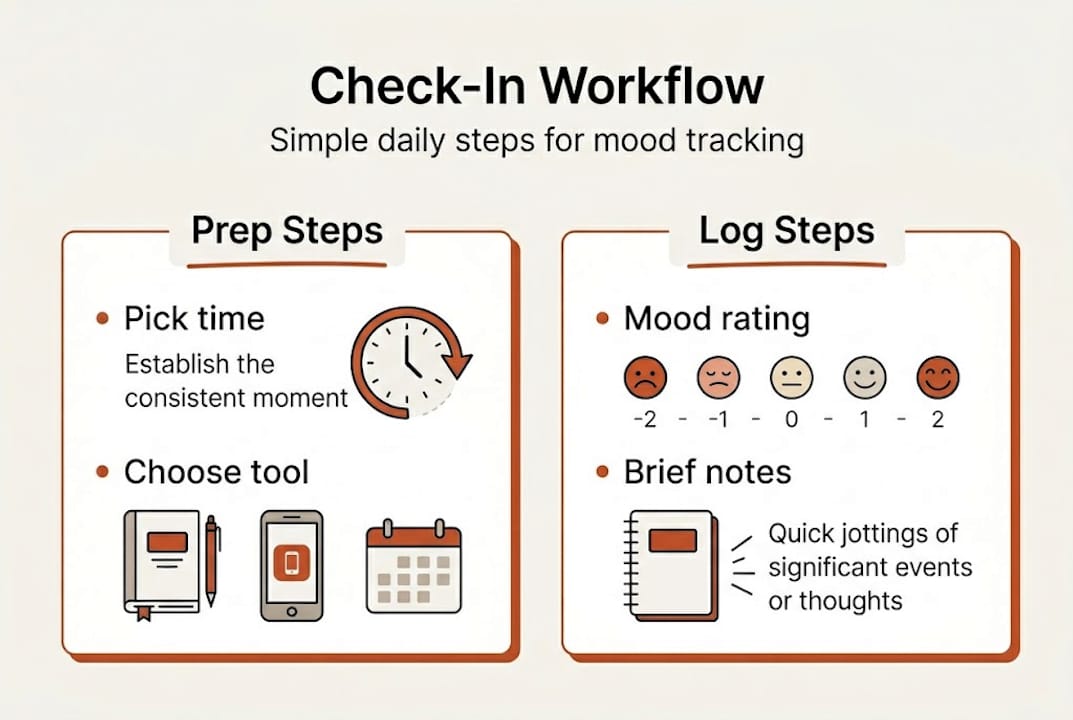
Once your tools and intentions are clear, it's time to put your workflow into action with daily practice. The structure below takes about five to ten minutes and covers the key emotional dimensions worth monitoring.
Step 1: Pick your check-in time and protect it. Morning check-ins work well for setting intentions and noticing how you slept. Evening check-ins are better for reflecting on what happened during the day. Some people benefit from a brief midday pulse check, especially after stressful events. There's no universally correct time. What matters is consistency. Pick a time that fits your existing routine, like right after your morning coffee or just before you brush your teeth at night.

Step 2: Rate your overall mood. Use a simple 1 to 10 scale. One means very low, ten means excellent. Don't overthink it. Your gut response is more honest than a carefully calculated score. This number becomes your baseline data point and is the easiest thing to visualize over time.
Step 3: Answer your daily prompts. Here's a set of evidence-informed prompts to get you started:
- How would I rate my mood right now on a scale of 1 to 10?
- How did I sleep last night, and how rested do I feel?
- What is my energy level today?
- What emotion is most present for me right now?
- Did anything trigger a strong reaction in me today?
- What is one thing I'm grateful for or that went okay?
- Is there anything I want to bring up with my therapist?
Step 4: Add a brief written reflection. Two to three sentences is enough. This is where you move from data collection into genuine self-awareness. What does today's mood number actually mean? What's behind it? This short narrative turns your check-in into something meaningful rather than just a number in a log.
Step 5: Note any coping strategies you used. Did you take a walk? Call a friend? Use a breathing exercise? Logging what helped (or didn't) gives you and your therapist a clearer picture of your coping toolkit.
Here's a comparison of active versus passive tracking approaches:
| Approach | How it works | Pros | Cons |
|---|---|---|---|
| Active tracking | You manually enter data each day | Reflective, intentional | Requires daily effort |
| Passive sensing | Wearable or app collects data automatically | No effort, continuous | Less reflective, needs context |
| Hybrid | Passive data plus brief daily entry | Best of both | Requires compatible tools |
Mood tracking tools show high internal consistency and reliability, meaning the data you collect is genuinely meaningful when reviewed over time.
Pro Tip: If you miss a day, don't try to reconstruct what you felt. Just start fresh the next day. Retroactive entries are often inaccurate and can distort your emotional record.
Troubleshooting: Common challenges and what to do about them
Even the best routines face setbacks. Here's how to navigate common roadblocks.
Boredom and repetition fatigue are the most common reasons people abandon mood tracking after a few weeks. Answering the same prompts every day can start to feel mechanical. The fix is to rotate a few prompts seasonally or add one curiosity question each week, something like "What surprised me today?" or "What am I avoiding?" Keeping one or two prompts constant gives you comparable data while fresh questions keep the practice engaging.
Forgetting to check in happens to almost everyone. The most effective solution is habit stacking, which means attaching your check-in to something you already do without fail. Pair it with your morning coffee, your lunch break, or your nightly wind-down routine. If you skip a day, just note the gap and move on. Skipping one day is normal. Skipping several days in a row, especially during a difficult period, can itself be a signal worth mentioning to your therapist.
Temporary mood dips from tracking are real and worth understanding. Research on mood tracking raises an important caution:
"In depression, repetitive tracking can cause temporary negative effects on psychological wellbeing. Adding therapeutic elements and clinician oversight can mitigate these effects."
This doesn't mean you should stop tracking. It means you should pay attention to how the practice feels. If you consistently feel worse after check-ins rather than more aware, that's worth discussing with your therapist. Platforms that include positive prompts and oversight can help balance the reflective process.
Here are signs that your tracking habit may need adjustment:
- You feel more anxious or self-critical after check-ins than before
- You're spending more than 20 minutes on each entry and feeling drained
- You're avoiding check-ins because they feel overwhelming
- Your mood scores have been consistently low for two or more weeks without any improvement
None of these are reasons to give up. They're signals to bring to your next therapy session. Your therapist can help you adjust the format, reduce the intensity, or add coping elements to balance the reflection.
Gaps in your tracking data can feel discouraging, but they're actually informative. A cluster of missed check-ins often coincides with a difficult period, high stress, or avoidance behavior. When you notice a gap, gently ask yourself what was happening during that time. That reflection alone can be valuable material for therapy.
Making your check-in insights work in therapy
After troubleshooting common blocks, you can deepen your workflow by using your insights for real therapeutic growth.
Your mood data is most valuable when it connects to your therapy work. A week of logged check-ins can reveal patterns that would take months to identify through memory alone. Maybe your mood consistently drops on Sunday evenings. Maybe your energy is lowest the day after social events. Maybe gratitude entries are harder to write during certain weeks. These patterns give your therapist specific, concrete material to work with.
Here's how to make your data genuinely useful in sessions:
- Review your past week's entries the day before your therapy appointment
- Note any recurring emotions, triggers, or themes you spotted
- Highlight one or two moments that felt significant, even if you don't fully understand why
- Bring your tracking tool to the session or export a summary if your app allows it
Research on integrating mood data with therapy shows that users have varied views on sharing their data directly with clinicians. Some find it empowering and efficient. Others feel exposed or judged. There's no right answer. You get to decide how much of your data you share and in what form. What matters is that you're using the insights to guide your own reflection, not just handing over raw numbers.
Using acceptance rather than judgment is a key mindset shift. When you review your data, resist the urge to grade yourself. A low mood score is not a failure. It's information. Ask "what was going on for me?" rather than "why was I so bad this week?" This small language shift makes a significant difference in how you relate to your emotional data over time.
One important statistic worth holding onto: consistent mood tracking, when paired with therapy, helps users identify emotional patterns significantly faster than therapy alone. That means your daily five-minute check-in is actively accelerating your therapeutic progress, not just supplementing it.
Respecting your own boundaries around data sharing is equally important. If bringing your mood log to a session feels vulnerable or anxiety-provoking, start by just summarizing what you noticed verbally. You don't owe your therapist a data report. The goal is richer conversation, not surveillance.
Why "perfect" tracking isn't the goal—focus on self-compassion
With these strategies in mind, it's important to zoom out and consider the bigger picture behind daily tracking.
Here at Between Sessions, we've seen a pattern that surprises a lot of people: the users who benefit most from mood tracking are not the ones who track perfectly every single day. They're the ones who track imperfectly but consistently, and who treat their gaps and low scores with curiosity rather than criticism.
Perfectionism in tracking is a real trap. When you miss a day and feel guilty, you're adding an emotional burden on top of the original challenge. That guilt can actually make the next check-in harder to start. Research confirms that negative effects from tracking are common in depression but tend to be short-term and manageable, especially when paired with acceptance-based strategies or clinician support.
The most honest thing we can tell you is this: your check-in doesn't need to be thorough to be valuable. A single mood rating and one sentence of reflection is infinitely more useful than a perfectly formatted entry you never write. Self-compassion is not a soft add-on to this practice. It is the practice. When you approach your emotional data with the same warmth you'd offer a good friend, the entire workflow becomes sustainable rather than exhausting.
Easily track your progress between therapy sessions
Building a consistent check-in habit is much easier when you have the right support structure around you.
Between Sessions is designed specifically for people like you, those who are actively working with a therapist and want to stay emotionally aware between appointments. The platform's features for tracking include calming daily prompts, automatic mood visualizations, and pattern insights that make your emotional data easy to understand and share. You don't have to organize your data manually or remember what you felt three weeks ago. Between Sessions does that work for you. Explore affordable options that fit your budget, or get started today and see how a structured daily check-in can strengthen every therapy session you have.
Frequently asked questions
What is the best time to do my daily mental health check-in?
The best time is whenever you can reflect consistently, whether that's morning or night, because regularity matters far more than the specific hour you choose.
Can daily mood tracking actually improve mental health?
Yes, digital mood tracking matches psychotherapy benchmarks for improvement, producing meaningful reductions in depression and anxiety symptoms over time.
Is it normal to feel worse when I start tracking my moods?
Yes, short-term dips in mood are common, especially in depression, but research shows these negative effects are temporary and do not indicate long-term worsening.
How do I make my check-in data useful for my therapist?
Review your patterns before each session and share themes or recurring emotions verbally or through your app's export feature, since integrating tracking with therapy sessions consistently produces the strongest outcomes.