

Therapy is powerful, but it only accounts for roughly one hour a week of your life. The other 167 hours? Those matter enormously. Research consistently shows that what you do between appointments shapes your progress just as much as what happens inside the therapy room. This guide walks you through evidence-based strategies that complement your sessions, accelerate your growth, and help you arrive at each appointment ready to go deeper. Whether you are in cognitive behavioral therapy (CBT), talk therapy, or another approach, these methods work.
Table of Contents
- Why supporting therapy between sessions matters
- 1. Embrace therapy homework for real progress
- 2. Track your thoughts and emotions consistently
- 3. Integrate self-care routines for mental resilience
- Comparison: Popular ways to support therapy between sessions
- Our perspective: Why therapy support shouldn't end at the office door
- Take the next step: Tools that support your progress between sessions
- Frequently asked questions
Key Takeaways
| Point | Details |
|---|---|
| Active engagement matters | Consistent effort between therapy sessions dramatically increases progress and lowers relapse risks. |
| Homework accelerates results | Evidence shows clients who complete therapy homework improve faster and benefit more overall. |
| Tracking boosts self-awareness | Regular mood and thought monitoring between sessions leads to deeper insights and better outcomes. |
| Self-care routines support therapy | Daily habits like exercise and mindfulness reinforce therapy gains and emotional resilience. |
| Combine strategies for best effect | Blending homework, tracking, and self-care delivers stronger, longer-lasting results than any one method alone. |
Why supporting therapy between sessions matters
Many people assume therapy works like a doctor's visit: you show up, receive treatment, and the healing happens. The reality is quite different. Therapy is more like physical rehabilitation. The exercises you do at home between appointments are what actually build strength over time.
The research backs this up clearly. Completing therapy homework between sessions significantly improves treatment outcomes, according to a recent meta-analysis reviewing decades of psychotherapy studies. The effect sizes are striking: Hedges' g of 0.78 for homework quality and 0.79 for homework quantity, both considered large effects in psychological research. That means the more consistently and thoughtfully you engage with between-session activities, the faster and more durably you improve.
Homework compliance also predicts faster symptom reduction, shorter overall treatment duration, and lower relapse rates. In practical terms, this means you could spend less time in therapy overall while achieving better, longer-lasting results.
Common types of between-session work vary by therapy style:
- CBT: Thought records, behavioral experiments, exposure exercises
- DBT (dialectical behavior therapy): Diary cards, skills practice logs
- ACT (acceptance and commitment therapy): Values clarification exercises, mindfulness practices
- Psychodynamic therapy: Journaling, dream logs, reflection prompts
"The gap between sessions is not empty time. It is the space where new habits take root and insights become real change."
The therapy support features available today make it easier than ever to stay engaged with your mental health work outside the office. Now that we've set the stage, let's see exactly how between-session activities fuel lasting progress.
1. Embrace therapy homework for real progress
Once you know the benefits, putting these into practice starts with understanding and embracing therapeutic assignments. Therapy homework is not busywork. It is a structured bridge between what you discuss in session and how you actually live your daily life.
Research from Ohio State University found that clients doing homework improve faster, and that early engagement with assignments predicts overall adherence and better long-term outcomes. In other words, if you commit to homework in the first few weeks of therapy, you are setting yourself up for success throughout the entire process.
Here are the most effective forms of therapy homework and how to approach each one:
- Thought records: Write down a situation that triggered a strong emotion, note the automatic thought that followed, then challenge it with evidence. This is a cornerstone of CBT and builds the skill of cognitive restructuring over time.
- Behavioral experiments: Test a belief by acting differently and observing the result. For example, if you believe speaking up in a meeting will lead to embarrassment, try it once and record what actually happens.
- Journaling: Free-form or structured writing helps process emotions, identify recurring patterns, and prepare meaningful topics for your next session.
- Skills practice: Whether it is breathing exercises, grounding techniques, or assertiveness scripts, practicing skills outside of session is what makes them automatic under stress.
- Reading or psychoeducation: Understanding the theory behind your treatment helps you apply it more intentionally.
Pro Tip: Set a specific time each day for your homework, even if it is just 10 minutes. Pairing it with an existing habit, like morning coffee or an evening wind-down, dramatically increases follow-through.
When you hit a wall with an assignment, do not just skip it. Write down what got in the way and bring that to your next session. Obstacles are often the most valuable material for therapy. You can track your progress and use therapy homework tools to stay organized and consistent between appointments.
"Homework is not about being a perfect student. It is about showing up for yourself in the spaces between sessions."
2. Track your thoughts and emotions consistently
After committing to homework, another powerful habit is consistent self-tracking between appointments. Tracking your mood and thoughts is not just journaling for its own sake. It is a data-gathering practice that makes your therapy sessions dramatically more productive.
When you walk into a session and can say, "I noticed I felt anxious every Tuesday morning, and it seems connected to a recurring thought about my performance at work," your therapist has something concrete to work with. Without tracking, those patterns often stay invisible.
Accuracy of thought records correlates directly with better outcomes and reduced relapse rates. The more precisely you capture what you are thinking and feeling in the moment, the more useful that information becomes.
Here is what to capture in your daily tracking:
- Triggers: What happened right before the emotion appeared? A conversation, a task, a memory?
- Automatic thoughts: What was the first thought that popped into your mind? Try to capture it word for word.
- Emotions and intensity: Name the emotion and rate it on a scale of 1 to 10.
- Physical sensations: Did you notice tension, a racing heart, or shallow breathing?
- Behavioral response: What did you do as a result? Avoid, confront, distract?
| Tracking method | Time required | Best for | Barrier level |
|---|---|---|---|
| Paper thought log | 5 to 10 minutes | CBT, structured work | Low |
| Mood tracking app | 2 to 5 minutes | Daily patterns, visual trends | Very low |
| Voice memo | 1 to 3 minutes | On-the-go capture | Very low |
| Detailed journal | 15 to 30 minutes | Deep reflection, processing | Moderate |
| Therapist worksheet | 10 to 20 minutes | Session prep, structured review | Moderate |
Pro Tip: Do not wait until the end of the day to track. Capture thoughts and emotions as close to the moment as possible. Memory fades quickly, and the details that matter most are often the first to go.
The mood tracking features on Between Sessions are designed specifically for this kind of gentle, consistent self-monitoring. Visual trend lines and calming prompts make it feel less like homework and more like checking in with yourself.
3. Integrate self-care routines for mental resilience
Alongside structured assignments and tracking, building resilience through daily habits can multiply your progress. Self-care is not a luxury or a buzzword. In the context of therapy, it is a clinical support strategy that keeps your nervous system regulated and your mind ready to do the hard work.

Therapists who include structured self-guided work alongside formal sessions see overall better outcomes, even when there are concerns about adding too much structure to therapy. The evidence points clearly toward the value of outside-session habits.
The most effective self-care practices for mental health support include:
- Mindful breathing: Even five minutes of slow, intentional breathing activates the parasympathetic nervous system, reducing the physiological stress response. Box breathing, where you inhale for four counts, hold for four, exhale for four, and hold for four, is simple and portable.
- Regular physical activity: Exercise is one of the most well-studied interventions for depression and anxiety. You do not need intense workouts. A 20-minute walk three times a week produces measurable mood benefits.
- Consistent sleep schedule: Sleep is when the brain consolidates emotional memories and regulates mood. Going to bed and waking at the same time each day, even on weekends, stabilizes your emotional baseline.
- Nutritional consistency: Skipping meals or relying heavily on caffeine and sugar creates blood sugar swings that amplify anxiety and irritability. Regular, balanced meals support mood stability in ways that are easy to overlook.
- Social connection: Isolation amplifies negative thoughts. Even brief, low-pressure social contact, a text to a friend or a short walk with a neighbor, buffers against rumination.
The key is identifying which routines fit your actual lifestyle rather than an idealized version of it. If you hate mornings, a 6 a.m. meditation practice will not stick. If you love cooking, building a mindful ritual around meal preparation might be your best entry point into daily self-care.
Pro Tip: Start with one self-care habit at a time. Stacking too many new behaviors at once leads to burnout. Master one routine for two weeks before adding another. Small, sustainable changes outperform dramatic overhauls every time.
Comparison: Popular ways to support therapy between sessions
Having explored each option, let's compare them head-to-head to help you find your best fit. Not every strategy works equally well for every person or every therapy style. This comparison helps you choose intentionally.
| Strategy | Effectiveness | Time commitment | Difficulty | Best therapy fit |
|---|---|---|---|---|
| Therapy homework | Very high | 10 to 30 min/day | Moderate | CBT, DBT, ACT |
| Mood and thought tracking | High | 2 to 10 min/day | Low | All therapy types |
| Mindfulness practice | High | 5 to 20 min/day | Low to moderate | ACT, mindfulness-based |
| Physical exercise | High | 20 to 45 min, 3x/week | Moderate | All therapy types |
| Journaling | Moderate to high | 10 to 30 min/day | Low | Psychodynamic, talk |
| Psychoeducation reading | Moderate | 15 to 30 min/week | Low | CBT, ACT |
| Sleep hygiene routines | Moderate to high | Ongoing habit | Low | All therapy types |
A few tips for blending multiple approaches effectively:
- Start with tracking. It requires the least effort and immediately improves session quality.
- Add homework next. Once tracking is a habit, structured assignments feel less overwhelming.
- Layer self-care last. Sleep, exercise, and nutrition form the foundation that makes everything else more effective.
- Review weekly. Spend five minutes each Sunday looking at what worked and what felt hard. Bring that review to your next session.
You can use progress tracking strategies to organize your approach and see which combinations are moving the needle for you.
Our perspective: Why therapy support shouldn't end at the office door
Here is an uncomfortable truth that does not get said enough: a single therapy session, no matter how insightful, cannot rewire years of learned patterns. Change happens in repetition, in the small moments when you choose a different response, notice a familiar thought, or practice a new skill under real-world conditions.
Some therapists worry that assigning homework makes therapy feel too formal or academic, potentially reducing the warmth and relational quality of sessions. That concern is real and worth respecting. But evidence shows overall superiority of homework-inclusive therapy over therapy without structured outside activities. The data does not suggest homework replaces connection. It suggests it deepens it, because you arrive at sessions with richer material and more specific questions.
What we find most compelling is how technology is quietly reshaping this equation. Digital tools do not replace the therapeutic relationship. They extend it. When you can log a difficult moment at 2 p.m. on a Wednesday and bring that precise record to your Friday session, you are giving your therapist a window into your actual lived experience, not just your memory of it.
The modern therapy support tools available today are designed to be gentle, not clinical. They do not feel like homework trackers or symptom checklists. They feel like a private space to check in with yourself, which is exactly what the gap between sessions needs.
The most effective therapy users we see are not the ones who have the most insight in session. They are the ones who stay curious about themselves in the hours and days between appointments. That curiosity, supported by the right habits and tools, is where real change lives.
Take the next step: Tools that support your progress between sessions
Ready to apply these strategies? Between Sessions offers tailored solutions that make consistent support simple.
Between Sessions is built specifically for people in therapy who want to make the most of the time between appointments. The platform offers gentle daily mood tracking with calming prompts, visual insights that reveal emotional patterns over time, and personalized suggestions based on your unique mental health journey.
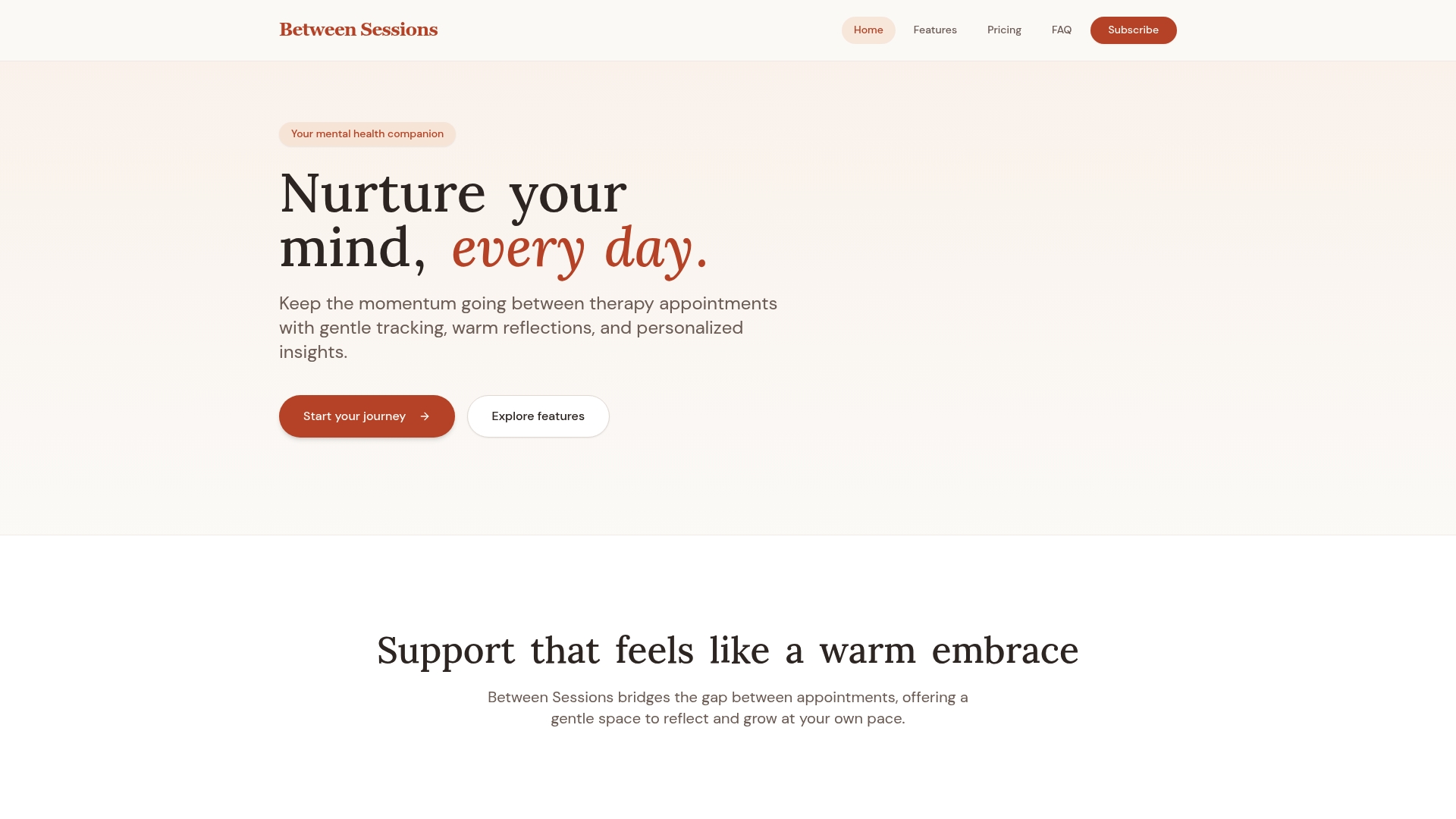
You do not need to overhaul your routine overnight. Start with one small habit, track it, and watch how it changes the quality of your sessions. Explore app features to see how Between Sessions supports your specific therapy goals, and see affordable plans that fit your budget. Your therapist works hard in session. Between Sessions helps you carry that work forward, every single day.
Frequently asked questions
What if I struggle to complete therapy homework each week?
Bring the struggle itself to your therapist. Completing therapy homework improves outcomes significantly, and collaborative problem-solving around barriers is one of the most productive uses of session time.
Do all therapists assign homework between sessions?
Not every therapy style requires formal homework, but CBT and most evidence-based approaches do. Homework compliance predicts faster symptom reduction, shorter treatment, and lower relapse rates, especially in CBT for depression and anxiety.
Which tools help track mood or progress outside of therapy?
Apps, structured journals, and therapist-provided worksheets all support regular mood and thought tracking. The best tool is the one you will actually use consistently, so choose based on your lifestyle and preferences.
How can I tell if between-session activities are working?
Watch for shifts in your mood patterns, reduced intensity of difficult emotions, and richer conversations in session. Clients doing homework improve faster, and consistent tracking directly correlates with better outcomes and lower relapse risk.