

Half of all adults seeking mental health support now use AI-based tools between therapy sessions, a number that would have seemed impossible just five years ago. That statistic captures both the excitement and the uncertainty swirling around mental health technology right now. Some people feel hopeful about having more support between appointments. Others worry about safety, accuracy, and whether an app can ever truly understand what they're going through. This article cuts through the noise, walking you through the four most significant technology trends reshaping therapy in 2026 and giving you a clear, grounded picture of when these tools genuinely help and when they fall short.
Table of Contents
- VR and AR: Redefining exposure therapy and somatic practices
- Wearables and passive sensing: Everyday emotional monitoring
- AI-powered digital therapy: Benefits, limits, and ethical considerations
- Next-gen hybrids and safety: Combining human guidance with technology
- A reality check: What most users and therapists overlook about tech-enabled support
- Take your therapy progress further with Between Sessions
- Frequently asked questions
Key Takeaways
| Point | Details |
|---|---|
| Immersive tech empowers practice | VR and AR tools allow you to rehearse coping skills safely between sessions. |
| Continuous monitoring matters | Wearables can alert you and your therapist to early signs of mood or sleep change. |
| AI is helpful, not a cure-all | AI apps support mild-to-moderate care, but clinician oversight is essential, especially in crisis. |
| Hybrid models lead the way | Combining human expertise with digital tools offers safety, personalization, and better outcomes. |
VR and AR: Redefining exposure therapy and somatic practices
With a new era of digital adoption underway, it's crucial to look at how immersive technologies are changing therapy work. Virtual reality (VR) and augmented reality (AR) are no longer science fiction accessories. They're becoming legitimate therapeutic tools that clients can use between sessions to practice skills their therapists have taught them.
The core idea is straightforward. VR creates a fully simulated environment, like a crowded elevator or a social gathering, where you can practice facing a feared situation without real-world consequences. AR overlays calming visuals or guided breathing cues onto your actual surroundings, making somatic practices more accessible at home. Both approaches give you a controlled space to rehearse coping strategies on your own schedule.
The evidence is genuinely encouraging. VR exposure therapy is comparable in effectiveness to real-world exposure, meaning you're not settling for a lesser option when you practice in a virtual space. For someone working through social anxiety, a phobia, or trauma-related avoidance, this is significant. You can repeat a scenario dozens of times without the logistical challenges of real-world practice.
What makes 2026's VR tools particularly interesting is the integration of AI-driven personalization. Instead of a one-size-fits-all simulation, newer platforms adapt the difficulty of scenarios based on your physiological responses, like heart rate and breathing patterns. If you're managing well, the environment gradually increases in challenge. If you're becoming overwhelmed, it dials back. This kind of responsive design mirrors what a skilled therapist does in a session.
That said, VR and AR carry real limitations worth knowing about. Physical side effects, including nausea and disorientation, affect a meaningful percentage of users. Without a therapist's guidance, it's also possible to accidentally re-traumatize yourself by pushing too hard, too fast. These tools work best as an extension of supervised therapy, not as a standalone replacement.
| Feature | Traditional exposure therapy | VR/AR exposure therapy |
|---|---|---|
| Setting | Real-world or therapist's office | Simulated or augmented environment |
| Accessibility | Requires scheduling | Available between sessions |
| Personalization | Therapist-guided | AI-adaptive in newer platforms |
| Safety net | Therapist present | Requires self-monitoring |
| Risk of overwhelm | Managed in real time | Possible without supervision |
Pro Tip: If your therapist uses exposure-based approaches, ask them specifically which VR scenarios align with your current treatment goals before using any app independently. This keeps your between-session practice intentional rather than random.
Wearables and passive sensing: Everyday emotional monitoring
While VR and AR reshape how we rehearse skills, another breakthrough centers on understanding what's happening in our bodies throughout the day. Wearables and smartphone sensors have quietly become some of the most powerful mental health tools available, precisely because they work without requiring you to do anything extra.
Passive sensing means your device collects data continuously in the background. Your smartwatch tracks heart rate variability (HRV), which is the variation in time between heartbeats and a reliable indicator of your nervous system's state. Your phone logs how much you're moving, how often you're picking it up, and even speech patterns during calls. Sleep trackers measure how long you sleep, how often you wake, and how much time you spend in restorative deep sleep. None of this requires you to fill out a form or answer a prompt.

The mental health relevance of this data is substantial. Wearables and smartphone sensors can detect early mood dips and prompt timely intervention, which is especially valuable in the days between therapy appointments when professional support isn't immediately available. A drop in HRV combined with disrupted sleep and reduced activity can signal an anxiety spike or depressive episode before you've fully registered it yourself.
| Metric tracked | What it reveals | Mental health relevance |
|---|---|---|
| Heart rate variability (HRV) | Nervous system regulation | Stress, anxiety, emotional resilience |
| Sleep duration and quality | Recovery and mood regulation | Depression risk, irritability, cognitive function |
| Physical activity levels | Energy and motivation | Depression, anxiety, overall well-being |
| Phone usage patterns | Behavioral changes | Social withdrawal, compulsive behavior |
| Speech tone and pace | Emotional state shifts | Early signs of mania or depression |
Here's how you can integrate wearables meaningfully into your therapy follow-up:
- Share your weekly data summaries with your therapist so they have objective context alongside your self-reported experience.
- Set personalized alerts for patterns you and your therapist have identified as early warning signs, like three consecutive nights of poor sleep.
- Use the data to inform your mood journal entries rather than replacing them, since numbers alone don't capture the full story.
- Review trends over weeks, not single days, to avoid overreacting to normal fluctuations.
By using health metric tracking alongside your therapy work, you create a richer picture of your emotional patterns than memory alone can provide. The key is treating wearable data as one input among many, not as a definitive diagnosis of how you're doing.
AI-powered digital therapy: Benefits, limits, and ethical considerations
Smart sensors keep us informed, but what about direct support and therapy? Enter AI-driven tools. AI-powered therapy apps and chatbots have matured significantly, and in 2026 they occupy a real and useful niche in the mental health ecosystem, though that niche has clear boundaries.
The strongest case for AI therapy tools is their availability. They're accessible at 2 a.m. when you can't sleep and your thoughts are spiraling. They respond without judgment, without fatigue, and without the scheduling friction of a human appointment. For people managing mild to moderate anxiety, low mood, or stress, research shows that AI therapy apps are as effective as standard interventions. That's a meaningful finding for the millions of people who can't access traditional therapy due to cost, geography, or availability.
The most effective AI tools in this space use structured therapeutic frameworks, particularly cognitive behavioral therapy (CBT) techniques, to guide users through thought records, behavioral activation, and relaxation exercises. They don't improvise. They follow evidence-based pathways, which is actually a strength when the alternative is no support at all.
However, the limits are just as important to understand:
- AI cannot handle crisis situations. If you're experiencing thoughts of self-harm or a psychiatric emergency, an AI app is not equipped to respond safely or effectively. Human support is non-negotiable in those moments.
- AI lacks genuine understanding. It processes language patterns, not lived experience. Nuanced grief, complex trauma, or relational dynamics often fall outside what current AI can meaningfully address.
- Hallucinations are a real risk. AI models can generate confident-sounding responses that are factually wrong or therapeutically harmful. This is especially dangerous in a mental health context.
- Bias in training data. Many AI systems perform less accurately for users from marginalized communities, meaning the support isn't equitable across all users.
- Privacy concerns remain significant. Mental health data is deeply sensitive. Not all apps handle it with the security standards it deserves.
"AI therapy apps show real promise for mild-to-moderate conditions, but they are not a substitute for professional care in complex or severe cases. The technology is a bridge, not a destination."
Ethical use of AI therapy tools means being honest with yourself about where you fall on the severity spectrum, keeping your therapist informed about which tools you're using, and treating AI support as a complement to human care rather than a replacement.
Next-gen hybrids and safety: Combining human guidance with technology
To make sense of AI and immersive tech, it's vital to address how human therapists and digital tools can work together safely. The most effective mental health technology in 2026 doesn't replace the therapeutic relationship. It extends it.
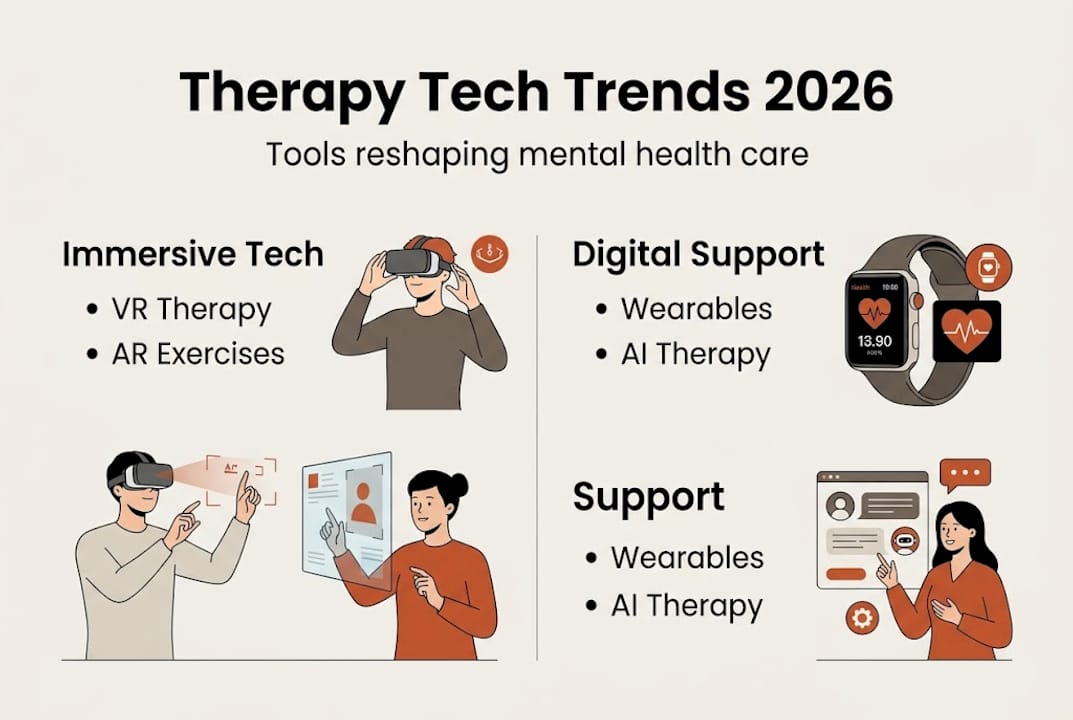
Hybrid models pair licensed clinicians with digital tools in a structured way. Your therapist might assign a specific VR scenario for you to practice at home, review your wearable data at your next appointment, or recommend an AI-based journaling tool that uses CBT prompts between sessions. The technology handles the between-session touchpoints. The therapist handles the interpretation, the relationship, and the clinical judgment.
Hybrid human-AI models with regulatory oversight and FDA-cleared digital therapeutics (DTx) are now considered the gold standard for safe and effective mental health tech use. FDA clearance matters because it means a tool has been evaluated for both safety and efficacy, not just released as a consumer app with no accountability. When choosing a digital mental health tool, looking for regulatory approval is one of the most practical filters available.
What does a next-gen hybrid model actually look like in practice? Consider a client working through panic disorder. Their therapist conducts sessions every two weeks. Between appointments, the client uses a VR app to practice interoceptive exposure (noticing physical sensations without catastrophizing), wears a device that tracks HRV and flags high-stress periods, and checks in with an AI chatbot that prompts brief grounding exercises when the wearable detects elevated stress. All of this data flows into a summary the therapist reviews before each session. The technology does the heavy lifting of continuity. The therapist provides the wisdom and clinical direction.
Key considerations for safer tech use in a hybrid model:
- Always disclose which apps and devices you're using to your therapist so they can assess fit with your treatment plan.
- Prioritize tools that have published clinical evidence or regulatory approval over those that rely solely on user testimonials.
- Establish clear boundaries with your therapist about what to do if a digital tool triggers distress between sessions.
- Review privacy policies carefully, particularly around data sharing with third parties.
Pro Tip: Ask your therapist if they have a recommended list of vetted digital tools. Many clinicians in 2026 now maintain curated resources for clients, saving you the overwhelming task of evaluating apps on your own.
A reality check: What most users and therapists overlook about tech-enabled support
After digesting the trends, let's get practical and honest about what really works in the real world. The honest truth is that technology in mental health creates a new kind of risk that doesn't get discussed enough: overconfidence.
When an app tells you your mood is trending upward, or when a chatbot validates your thinking, it's easy to feel like you're doing better than you actually are. The data becomes a substitute for genuine self-reflection rather than a prompt for it. We've seen this pattern emerge as digital tools proliferate: people engage with the technology but disengage from the harder, messier work of actually sitting with difficult emotions.
The irreplaceable value of a skilled human therapist is that they notice what you're not saying. They track the hesitation in your voice, the contradiction between what you report and how you present. No algorithm does that yet. Long-term success in tech-enabled mental health depends on hybrid models with clinician oversight, specifically to prevent the kind of diagnostic inflation and false reassurance that can emerge when technology operates without human checks.
The practical takeaway is this: use technology to stay connected to your mental health between sessions, but stay honest with your therapist about what the tools are actually showing you, including the data you're tempted to dismiss. The best outcomes happen when technology makes you a more informed participant in your own care, not when it makes you feel like you've got it handled on your own.
Take your therapy progress further with Between Sessions
For those seeking a safe, effective way to bring these tech trends into their real therapy journey, here's a step forward.
Between Sessions is built specifically for people like you: individuals who take their mental health seriously and want meaningful support between appointments. The platform offers gentle daily mood tracking with calming prompts, visual insights that reveal emotional patterns over time, and personalized suggestions that align with your unique mental health journey. It's the kind of tool that complements what you're already doing in therapy rather than competing with it. You can explore all features to see how they fit your current goals, check out see pricing for flexible options, or simply track your progress and start building a clearer picture of your emotional well-being today.
Frequently asked questions
Are AI therapy apps safe to use on their own?
AI apps can genuinely support mild to moderate symptoms, but they are not suitable for crisis situations or severe mental illness and should always complement, not replace, professional care.
What metrics do wearables track for mental health management?
Most wearables monitor HRV, activity, and sleep to detect early shifts in mood or anxiety levels that may not yet be consciously noticeable.
Can VR therapy replace in-person exposure therapy?
VR exposure therapy is comparable to in-person methods for many people, but therapist supervision remains important to manage the risk of overwhelm or accidental re-traumatization.
Why is hybrid human-AI support considered best practice?
Hybrid models with oversight reduce the risk of diagnostic inflation, bias, and overreliance on technology, while ensuring that clinical judgment remains central to your care.